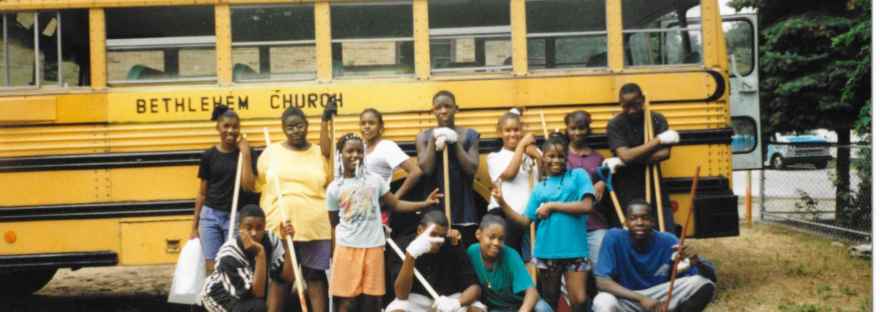
I was 20 years old on the day that Ms. Bell cussed me out in front of everybody, right there in the middle of the sweltering, littered park. Ms. Bell was the director of the Summer Youth Employment Project, a ministry of the mostly-Black Bethlehem Lutheran Church in Muskegon Heights, Michigan. I was the youth director at Bethlehem that summer thanks to a partnership between Bethlehem and my home congregation, an entirely White church in the small North Dakota town where I grew up.
Ms. Bell and I – together with Mr. Lewis – were in the park that day supervising the 20 or so Black teens who had found work and a sense of purpose in the Summer Youth Employment Project. As they raked and bagged trash and hurled jokes at each other, a White man with a steno pad walked through the park gate and approached me with a smile. He introduced himself as a local newspaper reporter, asking if he could interview me about the Summer Youth Employment Project and the kids whom the project engaged. “Of course!” I said with pride as I began to answer his questions.
The interview didn’t last long. The reporter was already leaving by the time Ms. Bell crossed the park. She was full-on yelling by the time she reached me. Her cussing hit me like a slap in the face as she asked me who in the hell I thought I was, how in God’s name I thought I could speak for her when she was the director of the program, and why the eff I didn’t have the good sense to send the reporter over to her when he arrived.
I was humiliated. And I deserved every word of the tongue-lashing Ms. Bell gave me that day.
I am White, and I had spent my entire life up until that summer in communities that were almost entirely White. In so many ways, I was wholly unprepared to face the racism that I didn’t even know was within me. I had no tools to analyze the ways that White supremacy culture functioned around me, and how I was complicit in it. Thank God, then, for Ms. Bell, who loved me enough to cuss me out for my dangerous ignorance, for my failure to recognize what it meant that a White news reporter automatically assumed that I – the only other White person in the park that day – must be in charge of all the Black folks working there.
That episode in the park was neither the first nor the last time I was forced to reckon with my own Whiteness that summer. Twenty-two years later, I’m still reckoning with it. Facing the ways that White supremacy culture continues to show up in my personal, professional, and civic life is hard. It is painful. It is embarrassing. It is scary. It is confusing. It is vulnerable.
It is also necessary.
George Floyd – an unarmed Black man – was murdered by a White police officer in Minneapolis, MN on Monday. Righteous anger over his death has spilled out in protests engulfing Minneapolis and other cities around the country. Race-based violence has snuffed out the lives of too many of our Black siblings. Ahmaud Arbery. Breonna Taylor. Sean Reed. Eric Garner. Philando Castile. Tamir Rice. Trayvon Martin. Sandra Bland. Michael Brown. Oscar Grant. Walter Scott. The list of Black lives lost is as gruesomely endless as the history of White supremacy in this country.
I sometimes hear other White people suggest that we are not responsible for this history. We did not create the systems of slavery and segregation and Jim Crow laws and redlining and other forms of institutional racism upon which this country was built. Those systems were created a long time ago. Most of us who are White never see the effects of these systems up close, and so we have the luxury of not really thinking about them. We have the privilege of looking at the problems as too overwhelming to fix. When these racist systems result in the death of yet one more Black person, we are paralyzed at best. We don’t know how to do anything beyond shaking our heads or sharing a headline on social media.
In her book Thinking About God, German liberation theologian Dorothee Soelle looks through theological lenses at a post-Holocaust, post-Cold War, growing-Third World crisis world. In considering the challenges facing God’s people and, indeed, the entire creation, she finally comes to this conclusion: “I am responsible for the house I did not build, but in which I live.”
I am responsible for the house I did not build, but in which I live.
My White siblings, this house in which we live is killing our Black neighbors. We must find the courage to take responsibility for it. We must encourage in one another the kind of vulnerability that opens us to learning what our Whiteness means and how it functions in the world. We must develop the kind of resiliency that will allow us to challenge one another in love – not to heap unproductive guilt on ourselves or on each other, but to see and to understand that our identities as White people are not neutral. We cannot change what we cannot see. Let us, together, learn how to see.
It is literally a matter of life and death.
Resources to begin:
“White Privilege: Unpacking the Invisible Knapsack” is a classic essay which includes an eye-opening list of seemingly benign ways that White privilege shows up in everyday life.
“Why Talk About Whiteness” is a brief, helpful introduction to exploring White culture. The article includes links to several essays and books for further reading.
The Whiteness Project is an interactive investigation into how people who identify as White, or partially White, understand and experience their race.
 Heidi Torgerson