a sermon on mark 13:24-37
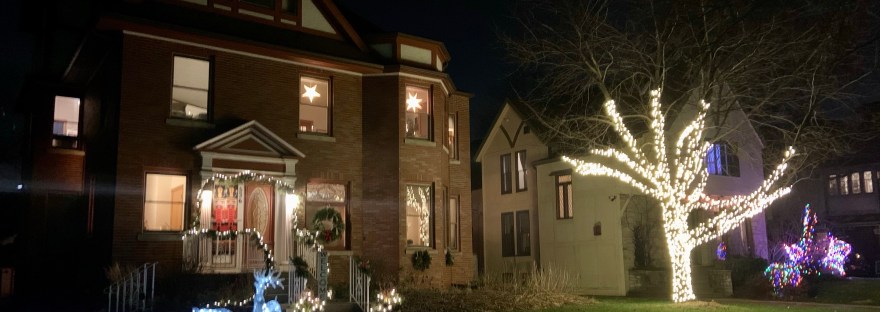
Jason and I took the puppy for a walk after dark a couple of weeks ago, and I was comforted to see how many people had decided to put up their Christmas lights way earlier than usual. It was almost like our neighborhood had come together in some instinctive, unspoken, collective effort to light up the lengthening night at the end of a really dark year. Our wonderful downstairs neighbors and landlords had the tree outside our house completely wrapped with twinkling white lights, weeks before they usually do – its stark, bare branches suddenly glowing with soft luminescence. I love the gently lit evergreen garland that drapes the entire length of the fence that runs along the house on the corner. That, too, has been up for weeks already. Lights twinkle and shine all the way up and down our street, outlining porches and windows and hanging from trees.
During the Advent season at our house, we place a candle in every window that faces the street – a practice I learned in my home growing up where my mom would do the same, offering a bit of warmth and a symbol of hope and welcome to any passersby. Our household is usually pretty adamant that we don’t decorate until Advent but we, too, instinctively turned to the light a bit earlier this year. Instead of using our window candles to mark the first Sunday of Advent this year, we decided to pull them out on the day when Gov. Pritzker announced statewide Level III COVID mitigations. It somehow felt like the only fitting response to yet one more reminder of what a dark place the world seems to be in.
We’re filling our lives with light at Grace, too, gathering over these four Sundays in Advent under the theme, “The Promise of Light.” We’ll light candles, one by one, in our own homes and here in the sanctuary as we dispel the deepening darkness outside. We’ll pull out spotlights and decorate our trees which will glow with warm light. Even our Catherine Lawn will be illuminated with a lighted path of prayer – a labyrinth – that you and the wider community are invited to walk as we prepare for Christmas; BYO mulled wine or hot tea in hand, if you like. And all of that feels right, especially at the end of 2020. When things feel especially dark, we turn toward the light.
I just wish that our Advent readings would get on board. Because while we’re turning toward the light, Mark’s gospel is talking of it being blotted out. “The sun will be darkened,” Jesus says in Mark 13. “The moon will not give its light. The stars will be falling from heaven and the powers in the heavens will be shaken.” This passage in Mark is often referred to as the “Little Apocalypse,” which is a whole genre of writing that’s kind of hard for our modern minds to make sense of, except for maybe within the context of movies about the end times, my personal favorite of which is the classic (?!) 90’s film Armageddon, starring Bruce Willis and Ben Affleck and Liv Tyler. (Say it with me, fellow Gen Xers – “Get off…the nuclear…warhead.”)
Apocalyptic literature has been around forever. People have been foretelling the end of the world essentially since the world began, reading an ultimate end into whatever war or natural disaster or global pandemic happens to be unfolding within their lifetimes. And unfortunately, much of the Bible’s apocalyptic writings have been misunderstood or misconstrued in order to scare people into supposed righteousness. I mean, the promise of escape from a terrible and suffering-filled End Time is enough to force all kinds of behaviors from people made afraid, whether or not those behaviors have anything to do with God. And who am I to say? Maybe the world really will end one day as the movie scriptwriters say – with some epic, terrifying battle between good and evil that punishes the unrighteous with unimaginable suffering. But that’s not really what the Greek word “apocalypse” means. It actually means “revelation,” or “unveiling” – an unveiling of things not previously known, and which are totally beyond the grasp of human understanding until the moment of their revealing.
Understood in this way, apocalyptic writings are hard not so much in a terrifying end-times way, but in a “humans want to know things, and we don’t like being told there are some things we can’t know,” kind of way. Our understanding of God is limited by our language and our experiences, and so we necessarily anthropomorphize God and domesticate the Divine. But these apocalyptic writings remind us that there is a certain wildness to God. They remind us that there is something to this whole gorgeous and troubling universe that is beyond our grasp, beyond our ability to see, no matter how much brightness we try to cast upon it with our window candles and Christmas tree lights.
Our faith is sometimes frustrated by this unknowing – perhaps especially in a year that has felt pretty apocalyptic by all standards, at least in that pop culture sense of the word. Advent anticipates the promise of the True Light of Christ, which…we’ve been anticipating and then celebrating for more than 2,000 years now. So if the Light of the World has already come, why the heck are we still living in such darkness? “Still Your children wander homeless;” we sing in one of my favorite hymns. “Still the hungry cry for bread; Still the captives long for freedom; Still in grief we mourn our dead.” We wake up to another day, try our best to put one leaden foot in front of the other, trudging along these wearying roads while we cry out to God along with Isaiah, “Oh that you would tear open the heavens and come down!” Standing as we are in the world as it is, Mark’s words sound almost mocking – “it’s not for you to know the hour or the day when everything will be made whole.”
Our faith is sometimes frustrated by this unknowing. But Church, our faith also rests in it. Just because the fullness of God’s work is hidden from us doesn’t mean it’s not unfolding, even now. There are cosmic movements and divine shifts happening around us all the time. Sometimes this movement of God brushes by us just closely enough for us to feel it – to notice the small opening in a relationship that had once been locked in fear, or to see the shape of a new life taking form when the old one has been taken from us, or to perceive the goodness of justice at work in ways both subtle and profound, in spite of the powers and greed that try to tamp it down. The Light of the World has already come. The work of faith is to rest on the edge of apocalypse – on the revelation and unveiling of holy activity and a divine plan that follows God’s timing, intention, and will.
It strikes me that the innumerable challenges of this past year might actually give us a chance at a deeper understanding of Mark. 2020 has revealed great chasms sin and pain and death in our world – chasms that many of us who enjoy certain kinds of privilege are often able to avoid having to see or feel. But it has also revealed great oceans of mercy and resilience and solidarity – things that point to God’s movement in the world. This is the holy tension of Advent – we live in the faith that God is at work, but there is so much that we do not know, and cannot know. Instead, we are called to a particular kind of alertness, a particular kind of woke-ness, a particular kind of attentiveness to what is right before us.
“Keep awake,” Jesus says. Because though the fullness of God’s wild and redeeming activity is beyond our grasp, we are also alive in it today. Right now. We are wrapped up in grace, held firm by promise, carried by hope, set free in God’s wildness right now. “Keep awake,” Jesus says, because there is work to be done – work set before us that is necessary for the mysterious, saving power of God to keep finding a foothold in this particular time and this particular space.
Keep awake, Church, because God is on the move and we’re already swept up in it. Keep awake, and keep doing whatever you can to light up these lengthening nights and dispel this deepening darkness. And in so doing, together we will illuminate the path for God’s saving work to keep finding its way in the world.
Amen.

 Heidi Torgerson