Who Are You?

an advent sermon on john 1:6-8,19-28

Let me start by reassuring you that you are not, in fact, experiencing liturgical déjà vu. This is the second week in a row that we’re hearing about a man named John and his call to make straight the way of the Lord. Now bear with me for a second as we untangle a few potentially confusing details, because there are two different people named John wrapped up in this mix. One of these Johns is sometimes called John the Evangelist – he’s the person who wrote the book of the Bible that we know as the gospel of John. In the verses we just heard, John the Evangelist tells us about a different person who is also named John, and that John is the subject of today’s gospel reading.

This John was also the subject of last week’s gospel reading from the book of Mark. And though John the Evangelist and Mark the gospel writer reference the same verses from Isaiah as they talk about the John who came to prepare the way of the Lord, there are some important differences in how they tell the story. That’s because John the Evangelist and Mark the gospel writer want to emphasize different things as they tell John’s story. It’s kind of like what happens when you ask two different people to describe a friend that they have in common. One might say, “Oh yeah! That Joe Schmo is hilarious! He’s got the quickest wit you can imagine!” While the other might say, “Joe Schmo? You’ll never meet a kinder person. He’s the kind of guy that just notices if you’re feeling off and makes a point to ask you about it.” Undoubtedly, Mr. Schmo is both hilarious and kind, but you’ll hear a different emphasis from each friend depending on their experience of Joe, or on the larger context of their relationship with him.   

So it is with John. Last week we met the locust-eating, camel-hear-wearing, wilderness-living John the Baptizer in the gospel of Mark. I love this fiery version of John with his call to repentance and his dramatic participation in Jesus’ baptism. For Mark, John’s identity as Baptizer is the most important part of his role in the whole salvation story. But this week we hear a very different take on John. The John of John’s gospel is decidedly less wild and fiery, and he’s also never called John the Baptizer in this account. Instead, he is John the Witness, whose most important role in the story of the Christ is not as one who baptizes, but as one who recognizes the true light when it appears – the Word made flesh who comes to dwell among us – and to call attention to it so that others might also recognize it and believe.

John is called to be a witness, but his testimony starts out in a rather unusual way as he responds to the religious officials’ question: “Who are you?” In contrast to the great “I am” statements that Jesus will make in this same gospel – I am the bread of life, I am the light of the world, I am the vine – John replies with a series of “I am not” statements. I am not the Messiah. I am not Elijah. I am not the prophet. I am not who you think I am, and anyway, this isn’t about me. Unsatisfied with this response, the religious officials ask him again, “Who are you?” And he replies with the words of Isaiah: “I am the next person in a long line of witnesses. I am a voice crying out in the wilderness.”

Church, this is a man with deep clarity about what his life is meant to accomplish. When asked “Who are you?” he says very little about himself. Instead, he responds with his vocation – with the thing that God placed him on this very earth to do.

“Who are you?”
“I am a witness. I am here to testify to the light.”

At the very beginning of this pandemic a very close friend of mine took up the practice of lighting candles for people and circumstances in need of prayer. Each evening, as darkness settled in, she and her family would light a small tea light for people who are part of their faith community; for friends or family members who were struggling; for situations of injustice and grief in the world. A name was scrawled on a small piece of folded yellow paper and placed next to each candle. When the tea lights ran out, pillar candles from around the house were brought to the table. And when those ran out too, various scented candles in jars became vessels for prayer, wafting a curious mixture of vanilla and pine as they flickered in the darkness. Each of those candles represented a situation of brokenness or sorrow, fear or weariness, injustice or pain. And though each wick produced only the smallest of flames, it was enough. It was enough to communicate to her beloved ones and to ones she would never meet, “You are not alone. I will bear the light for you when you cannot do it on your own.”

“Who are you?”
“I am a witness. I am here to testify to the light.”

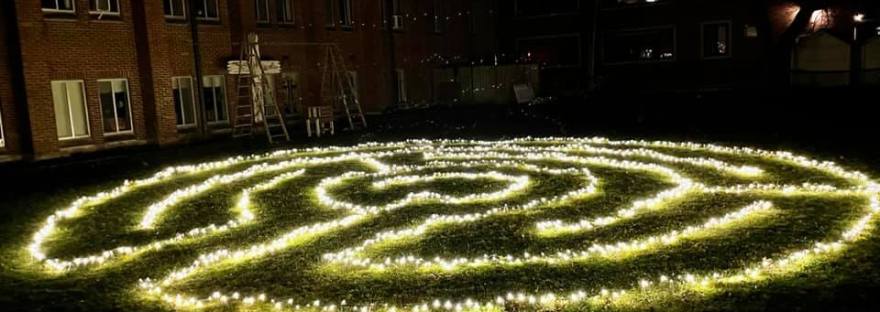
Karen, one of Grace’s staff members, shared with me on Friday that she’d had a conversation with John and Kathleen Westberg, longtime members with a deep history in our congregation. Earlier this week the Westbergs took a meditative walk through the lighted prayer path – the labyrinth – that is set up on our Catherine Lawn. Just as they were leaving a family of four approached in order to pray their own way through that same path. The Westbergs called to share with Karen what a spiritually moving experience that was for them, and to comment on the hope they experience in the many creative ways that churches finding to reach out to their communities in this difficult time.

“Who are you?”
“I am a witness. I am here to testify to the light.”

In seemingly powerless places in our community and around the world you, the people of God at Grace Lutheran Church of LaGrange, are echoing the prophet Isaiah’s words through your actions: “to bring good news to the oppressed, to bind up the brokenhearted, to proclaim liberty to the captives…to comfort all who mourn.” You knit prayer shawls that literally wrap our struggling members in God’s care. You pack socks and soap and shampoo and love into bags for veterans experiencing homelessness. You cook or donate healthy meals to BEDS Plus for people who are finding temporary shelter in hotels, and for families who are experiencing food insecurity. You pack backpacks full of food for kids who receive free or reduced-COST lunch at school but who often experience hunger on the weekends. You continue to drop off gifts for the Secret Santa program through Pillars Community Health, and food for the St. Francis food pantry. You send cards and make phone calls to members who are ill or grieving or even celebrating milestones. You take the time to record yourselves and your children praying and lighting candles and singing songs and telling stories so that God might meet us in worship through this whole Advent & Christmas season.

“Who are you?”
“I am a witness. I am here to testify to the light.”

Church, the clear call on John’s life was that he be a very human witness to a very mysterious, cosmic event. The Word will take on flesh and dwell among us, and he will be the light of the world, a light that no darkness can overcome. John’s role in the story of salvation is to call the whole world’s attention to that light – to point us toward the insistent glimmer growing in the dim corners where we do not expect light to be – just in case we happen to be too weary or too distracted to notice it otherwise. On this third Sunday of Advent, let this as our call, too – to keep our eyes open for even the faintest hints of light in the midst of darkness, and to point others to that light:
Light that brings healing and hope and release.
Light that carries quiet joy into places we cannot imagine it.
Light that meets the needs of hungry bodies and the hunger of our own souls.
Light that brings justice into the lives of forgotten peoples and places.
And in the words of Jan Richardson,
“Light that endures in the midst of things that seem unendurable,
and persists even when everything seems in shadow and grief.”

Who are you?
You are witnesses. Testify to the light.

Amen.

the headline photo is of the lighted labyrinth located on our church’s lawn through the advent & christmas seasons. it is intended as a gift of quiet meditation for the whole of our community.

the jan richardson quote is from her poem “Blessed Are You Who Bear the Light.”
Light Up the Night

a sermon on mark 13:24-37

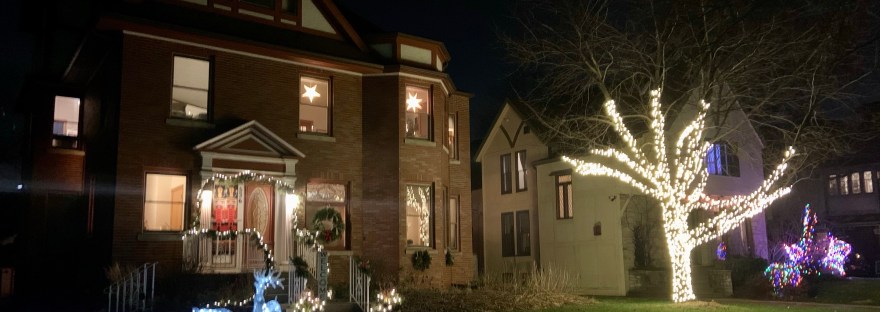
Jason and I took the puppy for a walk after dark a couple of weeks ago, and I was comforted to see how many people had decided to put up their Christmas lights way earlier than usual. It was almost like our neighborhood had come together in some instinctive, unspoken, collective effort to light up the lengthening night at the end of a really dark year. Our wonderful downstairs neighbors and landlords had the tree outside our house completely wrapped with twinkling white lights, weeks before they usually do – its stark, bare branches suddenly glowing with soft luminescence. I love the gently lit evergreen garland that drapes the entire length of the fence that runs along the house on the corner. That, too, has been up for weeks already. Lights twinkle and shine all the way up and down our street, outlining porches and windows and hanging from trees.

During the Advent season at our house, we place a candle in every window that faces the street – a practice I learned in my home growing up where my mom would do the same, offering a bit of warmth and a symbol of hope and welcome to any passersby. Our household is usually pretty adamant that we don’t decorate until Advent but we, too, instinctively turned to the light a bit earlier this year. Instead of using our window candles to mark the first Sunday of Advent this year, we decided to pull them out on the day when Gov. Pritzker announced statewide Level III COVID mitigations. It somehow felt like the only fitting response to yet one more reminder of what a dark place the world seems to be in.

We’re filling our lives with light at Grace, too, gathering over these four Sundays in Advent under the theme, “The Promise of Light.” We’ll light candles, one by one, in our own homes and here in the sanctuary as we dispel the deepening darkness outside. We’ll pull out spotlights and decorate our trees which will glow with warm light. Even our Catherine Lawn will be illuminated with a lighted path of prayer – a labyrinth – that you and the wider community are invited to walk as we prepare for Christmas; BYO mulled wine or hot tea in hand, if you like. And all of that feels right, especially at the end of 2020. When things feel especially dark, we turn toward the light.

I just wish that our Advent readings would get on board. Because while we’re turning toward the light, Mark’s gospel is talking of it being blotted out. “The sun will be darkened,” Jesus says in Mark 13. “The moon will not give its light. The stars will be falling from heaven and the powers in the heavens will be shaken.” This passage in Mark is often referred to as the “Little Apocalypse,” which is a whole genre of writing that’s kind of hard for our modern minds to make sense of, except for maybe within the context of movies about the end times, my personal favorite of which is the classic (?!) 90’s film Armageddon, starring Bruce Willis and Ben Affleck and Liv Tyler. (Say it with me, fellow Gen Xers – “Get off…the nuclear…warhead.”)

Apocalyptic literature has been around forever. People have been foretelling the end of the world essentially since the world began, reading an ultimate end into whatever war or natural disaster or global pandemic happens to be unfolding within their lifetimes. And unfortunately, much of the Bible’s apocalyptic writings have been misunderstood or misconstrued in order to scare people into supposed righteousness. I mean, the promise of escape from a terrible and suffering-filled End Time is enough to force all kinds of behaviors from people made afraid, whether or not those behaviors have anything to do with God. And who am I to say? Maybe the world really will end one day as the movie scriptwriters say – with some epic, terrifying battle between good and evil that punishes the unrighteous with unimaginable suffering. But that’s not really what the Greek word “apocalypse” means. It actually means “revelation,” or “unveiling” – an unveiling of things not previously known, and which are totally beyond the grasp of human understanding until the moment of their revealing.

Understood in this way, apocalyptic writings are hard not so much in a terrifying end-times way, but in a “humans want to know things, and we don’t like being told there are some things we can’t know,” kind of way. Our understanding of God is limited by our language and our experiences, and so we necessarily anthropomorphize God and domesticate the Divine. But these apocalyptic writings remind us that there is a certain wildness to God. They remind us that there is something to this whole gorgeous and troubling universe that is beyond our grasp, beyond our ability to see, no matter how much brightness we try to cast upon it with our window candles and Christmas tree lights.

Our faith is sometimes frustrated by this unknowing – perhaps especially in a year that has felt pretty apocalyptic by all standards, at least in that pop culture sense of the word. Advent anticipates the promise of the True Light of Christ, which…we’ve been anticipating and then celebrating for more than 2,000 years now. So if the Light of the World has already come, why the heck are we still living in such darkness? “Still Your children wander homeless;” we sing in one of my favorite hymns. “Still the hungry cry for bread; Still the captives long for freedom; Still in grief we mourn our dead.” We wake up to another day, try our best to put one leaden foot in front of the other, trudging along these wearying roads while we cry out to God along with Isaiah, “Oh that you would tear open the heavens and come down!” Standing as we are in the world as it is, Mark’s words sound almost mocking – “it’s not for you to know the hour or the day when everything will be made whole.”

Our faith is sometimes frustrated by this unknowing. But Church, our faith also rests in it. Just because the fullness of God’s work is hidden from us doesn’t mean it’s not unfolding, even now. There are cosmic movements and divine shifts happening around us all the time. Sometimes this movement of God brushes by us just closely enough for us to feel it – to notice the small opening in a relationship that had once been locked in fear, or to see the shape of a new life taking form when the old one has been taken from us, or to perceive the goodness of justice at work in ways both subtle and profound, in spite of the powers and greed that try to tamp it down. The Light of the World has already come. The work of faith is to rest on the edge of apocalypse – on the revelation and unveiling of holy activity and a divine plan that follows God’s timing, intention, and will.   

It strikes me that the innumerable challenges of this past year might actually give us a chance at a deeper understanding of Mark. 2020 has revealed great chasms sin and pain and death in our world – chasms that many of us who enjoy certain kinds of privilege are often able to avoid having to see or feel. But it has also revealed great oceans of mercy and resilience and solidarity – things that point to God’s movement in the world. This is the holy tension of Advent – we live in the faith that God is at work, but there is so much that we do not know, and cannot know. Instead, we are called to a particular kind of alertness, a particular kind of woke-ness, a particular kind of attentiveness to what is right before us.

“Keep awake,” Jesus says. Because though the fullness of God’s wild and redeeming activity is beyond our grasp, we are also alive in it today. Right now. We are wrapped up in grace, held firm by promise, carried by hope, set free in God’s wildness right now. “Keep awake,” Jesus says, because there is work to be done – work set before us that is necessary for the mysterious, saving power of God to keep finding a foothold in this particular time and this particular space.

Keep awake, Church, because God is on the move and we’re already swept up in it. Keep awake, and keep doing whatever you can to light up these lengthening nights and dispel this deepening darkness. And in so doing, together we will illuminate the path for God’s saving work to keep finding its way in the world.

Amen.

Laugh it Up!

a sermon on Genesis 18:1-15; 21:1-7, as part of the Unraveled worship series

I have a very serious question for you this morning, Church. When was the last time you really laughed? I’m not talking about a little chuckle. I mean, when was the last time you had the throw-back-your-head, tears-running-down-your-cheeks, gasping-for-air kind of full-body laugh? Was it just a few minutes ago? (And if it was, would you call me after worship and tell me the story so I can laugh along with you?!) Was it a few months ago? Was it pre-pandemic? Was it so long ago that you can’t even remember?

They say that laughter is the best medicine, but it feels like reasons for laughter have been in short supply lately.

You know, because of All The Things.

Over the last 10 weeks we’ve been exploring biblical narratives of unraveling. I know that a series like this is new for Grace, so I’ve appreciated hearing from so many of you about how appropriate the theme has felt to the time we’re living in. The news of another stay-at-home advisory stands as a stark reminder to how this pandemic has unraveled pretty much everything about our lives. A damaged sense of public trust in this divided country that’s managed to politicize even this global pandemic adds another layer to the fraying. And we’ve been talking about pandemics and divisions for so long now that I’m honestly pretty much sick of talking about it. We all know. Things are really hard. They might get harder yet before they get better. And when things do get better, they’ll still be different. COVID has changed everything, and there’s just no going back to life exactly as we once knew it.

That’s a lot of bad news to try and process, even though we’ve had 8 months of practice by now. So lemme just cut to the chase and tell you the good news, which comes to us in this delightful little story from the book of Genesis:

When we think things are ending, God is just getting started.

In case it’s been awhile since you’ve encountered the story of Abraham & Sarah – who are known as Abram and Sarai in earlier chapters of Genesis – let me give you a little back story. We first encounter Abraham in Genesis 12 when God calls him, seemingly out of the blue, to leave his homeland and his people and go to a land he’s never seen. Along with God’s call comes a threefold promise: first, that Abraham will be a “great nation” with as many descendants as there are stars in the sky; second, that Abraham and his descendants will inherit the land of Canaan; and third, that they will be a blessing to the whole world. Well, all of that is well and good, but there’s one pretty big hiccup in this whole “great nation” promise. Abraham has no children, and his wife, Sarah, is barren. It’s pretty hard to become a “great nation” if you don’t even have one child.

Well, they can’t produce an heir but they also can’t let the promise slip through their fingers, so Abraham & Sarah take matters into their own hands. They give Sarah’s handmaid, Hagar, to Abraham as a concubine, and Hagar gives birth to a son that she names Ishmael. Abraham and Sarah will later banish Hagar and Ishmael to the desert where they almost die. That’s a story for a different day, but their cruel choice is one of a number of pretty crappy decisions Abraham and Sarah will make as they try to follow the God who called them. I mention it as yet one more reminder that God has this habit of using people who are sort of messed up to do some great things which, frankly, gives me some hope for all of us!

Anyway, after Ishmael is born, Sarah gets her own blessing from God, and her own promise, as well. God promises that Sarah will give Abraham a son – a true heir – and that she will be the mother of nations and the bearer of kings. Cool, cool, cool. This is an amazing promise. It just has one problem. By the time God makes it, our sister Sarah is 90 years old. Abraham knew as well as we do that 90-year-old women don’t have babies, so when God tells him this plan Abraham literally falls on his face laughing at the absurdity of the idea. He reminds God that he already has Ishmael so maybe God could just make it easier on all of them and make Ishmael his heir, but God’s like, “Nope. I’m going to make Ishmael a great nation, too, but you’re going to have a true heir and my covenant will be with him – the one that your wife, Sarah is going to bring into the world.”

Which brings us to the part of the story we just heard a few minutes ago. Abraham, wiping his dusty face as he sits outside his tent in the heat of the day, notices three strangers standing nearby. When he sees them he kicks those 100-year-old legs into gear, running toward them and bowing down before them. Hospitality was a big deal in that time, and Abraham spares nothing in making sure that these men can rest and enjoy a good meal made from the finest flour and meat he has. As the strangers eat and drink they ask about Sarah, wondering where she is. Well, she is inside the tent, eavesdropping on this conversation in which one of the strangers tells Abraham that Sarah will have a son. I love, love, love Sarah’s cheekiness as she listens from the tent. I imagine her catching a glimpse of her 100-year-old husband with his thin wisp of white hair, his sagging skin, and his slightly bent, bony shoulders as she laughs to herself. “A son?! Can two old people like us even have pleasure anymore?!” (I’m pretty sure I would have liked Sarah.) The Lord overhears Sarah’s laughter and asks Abraham, “Why did she laugh? Is anything too wonderful for the Lord?”

Is anything too wonderful for the Lord?

Sarah & Abraham’s dream of having a child had been long dead, but God keeps this promise to Sarah. She gives birth to a son and they name him Isaac, which means “laughter” in Hebrew, because, as Sarah says, “God has brought laughter for me; everyone who hears it will laugh with me.” 

Friends I want to remind you that the Bible is not a science book. Rather, the Bible is a book of many books that tells the long story of God’s extravagant love and mercy poured out on the world. Though I wouldn’t put anything past our God, wondering over whether a 90-year-old woman in the ancient world really, actually conceived and bore a child misses the point. The point is that when we think things are ending, God is just getting started.

I don’t know all of the details of what’s come undone in your lives in these difficult days. I don’t know all of the endings, all of the unravelings. But I do know this: we are loved and led by a God of promise. The promises of God might not always be easy to see or touch or understand. They might seem absurd or impossible and they might take 100 long and difficult years to unfold. But they are there.

Next week will be the last in our Unraveled worship series. It will also be our Commitment to Connect Sunday, where we will invite one another to connect – or re-connect – to Grace’s ministries in some specific ways. And then we’ll move into Advent, a season that begins with another unexpected promise of a child; this time, a child whose name means not “laughter,” but “savior.” A child who will be for us God’s ultimate promise that where we see an ending, God is just getting started.

My prayer for you today, dear church, is that this little story from Genesis would fill you with a sense of the promises of God in your own life. Promises that, if we could see the ending, might have us falling on our faces in a fit of laughter like Abraham, or chuckling behind the tent door like Sarah. Promises that fill God’s own heart with laughter because God delights in you, and because God delights in the holy absurdity of unexpected blessing that is always, always unfolding in our lives.

So laugh it up, beloved of God. This is not the end. God is just getting started.

Amen.