a sermon for Trinity Sunday
Today is Trinity Sunday, the day in the liturgical calendar when we celebrate the Christian doctrine of, well, the Trinity – the three persons of God – Father, Son, & Holy Spirit – who are somehow also one God.
It might be an understatement to say that the doctrine of the Trinity is a mystery. But it’s not a mystery in the Scooby Doo show kind of way; you know, where Shaggy and Fred and Velma and Daphne and Scooby ride around in the Mystery Machine, following a series of clues to solve the thing. Rather, the Trinity is a mystery in the way that good poetry is mystery. In poetry, phrases mingle and bounce over one another to communicate something deeper, something more profound, something beyond the literal meaning of the words themselves.
You already know about my nerdy appreciation for the liturgical calendar, so let me tell you why I appreciate Trinity Sunday. It’s because the poetic mystery of the Trinity tells us about the nature of God. We believe in one God, but God’s one-ness is revealed in the beautiful, interwoven, inextricable connection among three persons. To put it another way, the doctrine of the Trinity tells us that relationship is at the very core of God’s being. God IS relationship. God’s deepest essence is expressed in the community of the Three-in-One. And the mission, or work, of our Trinitarian God flows out of the poetry of that relationship.
Church, I’ve been doing a lot of thinking and praying about relationship lately. In particular, I’ve been thinking and praying about how different it has been to try and develop a relationship with you in these first few months of our ministry together. We only know each other by video. I have a deep sense that I’m speaking to you when I preach or when I record a Wednesday video message for you, but I can’t see you on the other side of the camera. I can’t see in the moment how you’re receiving what I’m sharing; how things are landing for you. I know a whole lot about the human condition generally, but I don’t really know you. I don’t yet know your stories or your families or your fears or your hopes.
And you don’t really know me, beyond whatever opinion you’ve formed through these various virtual platforms. Though I hate it as much as you do, it is good and right that we continue to protect each other and our neighbors by remaining apart. But the physical distance just means it’s also really hard to develop any texture to our relationships, you know? I’m reduced to pixels on a screen or words in a newsletter as you search for clues that will tell you whether I’m trustworthy, whether I can relate to your experiences of God and of the world, whether I can be counted on to love you faithfully.
It strikes me that our situation isn’t, in some ways, so unlike the ways relationships unfold – or maybe better put, don’t unfold – in our country, especially between communities of different races. We are members of a congregation that is part of the whitest denomination in the United States. We live in one of the most racially segregated cities in the country. What many of us know about communities that are home mostly to people of races different from our own is often only by video…24-hour cable news feeds or viral social media clips and the like. Sure, lots of us have friends or colleagues or acquaintances who are of a race different than our own. Some of us have families that are mixed-race. But most of us aren’t regularly immersed in the community life of those from whom we are different. We don’t know each other’s stories, or families, or fears, or hopes. We don’t know each other beyond whatever opinions we’ve formed from external, secondary sources that find their ways into our own largely insulated, echo-chamber-y lives.
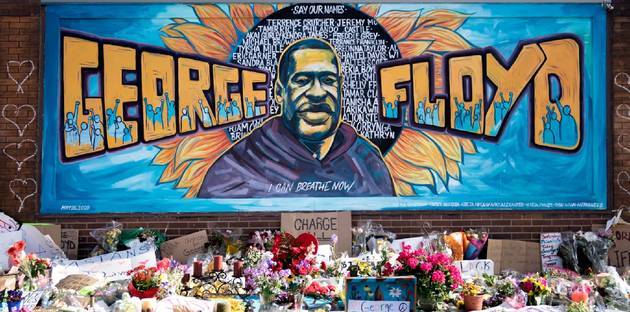
Our brother, George Floyd, was killed a couple of weeks ago over a $20 bill. In the wake of his death our country has erupted into demonstrations and protests and acts of peaceful civil disobedience the likes of which many of us have not seen in our lifetimes. Unfortunately, looting and destruction of property have accompanied some of those protests, igniting yet one more set of polarizing conversations in an already-excruciatingly polarized country. Depending on where we sit, we are angry, or scared, or anguished, or hopeful, or ambivalent, or maybe all of those things at once. Whether we wanted it or not; whether we were ready for it or not; we’ve been thrust into a national conversation about race; about the ways that the systems and structures of our country have been set up to benefit some people at the profound expense of others. And we’re trying to have that national conversation without any real base in the kind of poetic relationship we see in the Trinitarian God of love, of peace, of justice, of salvation.
And now I’m trying to have it with you, and I’m trying to encourage us to have it with one another, without any real base in the kind of poetic relationship reflected in our Trinitarian God. I’ll be honest, friends. It’s a little scary. There are those who would say a pastor shouldn’t preach about anything that can possibly be construed as political, and certainly not just weeks after having started in ministry together. Because really, there’s no way for you to possibly know yet how much I already love you; how much I yearn to know the foundational stories of your lives and how those stories have shaped your faith and your worldviews. And I know that there’s a whole diversity of worldviews represented in our congregation. We’re not of one mind on probably anything, really, and that’s okay. That might make it a little scarier to talk about hard stuff, but it doesn’t mean we shouldn’t do it. Not for the sake of “being political,” but for the sake of our souls.
Relationship is God’s essence, and so when the relationships among God’s people are fractured, when beloved children of God are being killed, when some of God’s people are screaming out in grief and pain, that’s not about politics. That’s about our faith. It’s about our faith in the God of Moses and Miriam and Aaron, who led the people out of slavery and into freedom. It’s about our faith in the God of the prophets, who remind us what God requires: that we do justice, love kindness, and walk humbly with God. It’s about our faith in Jesus, who showed us that we can’t love God without also actively loving our neighbor.
In my weekly video message that goes out on our Wednesday e-mail listserv, I invited those of us who are white into a congregation-wide conversation based on the book Waking Up White, And Finding Myself in the Story of Race. In that invitation I reflected on how most of us who are white have never learned how to talk about race; about how learning to talk about race is a matter of life and death for God’s beloved people; and about my absolute confidence that we can approach these conversations in an open-hearted, grace-filled, non-judgmental way.
Learning how to talk about race is, for most of us who are white, like learning a new language. And so we’re going to be awkward together. We’re going to make mistakes together. We’re going to ask questions together and maybe feel a little scared or a little vulnerable together. Our prayer is that, by the end of the summer, about 100 people at Grace will have joined this conversation. I trust that these conversations will be faithful first steps in allowing those of us who are white to more fully uncover and understand our own stories of race so that we can more deeply understand the stories of others. And learning to understand the stories of others might give us one small foothold to join the Great Healer in restoring health to our collective brokenness. Please reach out to me or a member of the staff if you’d like to know more about what these conversations might be like and how to join a group.
Did I mention that this feels a little scary as your new pastor? But I know we’re up to it, and here’s how I know: it’s because we were made in the image of the poetic, relational God who we celebrate on this Trinity Sunday. The Genesis story that was so beautifully presented by some of our families reminds us that we were formed from the dust of the earth – the black earth, the brown earth, the white earth, the yellow earth, the red earth.* The Three-in-One God whose very essence is relationship breathed life into the dust of the earth and said, “you are like me – made for relationship, created for community. When you forget who you are; when you forget that you belong to each other, look to me and remember.
I am the Father, who called all things into being and still calls them good.
I am the Son, who became one of you and died out of deepest love.
I am the Holy Spirit, who sets your tongues ablaze to speak courageous blessings into this broken world.
I am your God.
You were made for this.
Do not be afraid.”
* This phrasing was inspired by the poem “Remember,” by Joy Harjo, US Poet Laureate and member of the Mvskoke Nation.
The mural in the headline photo was painted by Greta McLain, Xena Goldman, and Cadex Herrera at the site where George Floyd was killed.

 Heidi Torgerson