a sermon on john 14:1-14
Texts like this one from the gospel of John can be a bit tricky for a preacher, mostly because this one is so familiar. Church people have heard it a thousand times, and a whole lot of people who aren’t so familiar with church have also heard it a bunch. For example, regular church attender or not, I’d guess that most of us have heard this text read at at least one funeral. Traditional funeral sermons on this text encourage us to imagine Jesus putting his carpentry skills to good use for us in heaven, making up a bright and shiny room for us and our loved ones to call home when our time on Earth is done. Others of us have heard this text used to influence interfaith conversations, usually by suggesting that people of other religious traditions have no place in God’s reign and most certainly will NOT be our neighbors in any of those aforementioned bright and shiny heavenly rooms. The common theme here is that most us have learned to hear these words from John and cast our thoughts away from the complexity of this earthly life and instead to look heavenward toward the glories awaiting us in our Father’s house after we die.
I gotta say, I understand the tendency. Jesus’ words are reassuring. “Do not let your hearts be troubled! In my Father’s house there are many rooms, and I’m going to prepare a place for you. And if I go and prepare a place for you, I will come back and bring you with me so that where I am, you will be also.” Part of my own weary soul breathes a tiny sigh of relief when I hear these words, because Lord knows – literally – that words of assurance are hard to come by in these days. Lord knows – literally – that its exhausting to battle our ways through the miniscule and massive challenges surrounding us every day right now. If you saw my weekly video message on Wednesday you heard me and my husband Jason talking about what a rough week it’s been around our house. Patience has been in shorter supply. Sadness and maybe even some atypical low-grade depression are more at the surface. We’ve been feeling frustrated about pretty much All The Things and also a little afraid of the long-haul nature of this COVID crisis, and of the reality that life isn’t ever going to be quite the same anymore.
I know because you’ve told me that things are feeling heavy for you, too. Loneliness is taking a new kind of toll for many of us, even for the proudest self-proclaimed introverts among us. Some of us are regular visitors to hospitals and clinics for health concerns that have nothing to do with COVID, except that they suddenly have everything to do with COVID because showing up to a hospital feels risky right now, even when it’s necessary. Some of us are separated from loved ones who are ill, or who are nearing the end of life, or who have died very recently, and the grief of all of that is just too much to bear. Some of us have lost jobs or have taken significant pay cuts or have been furloughed, and the financial stress on top of everything else is enough to almost topple us. Some of us live with depression or anxiety that might be relatively well-managed in normal times, but these aren’t normal times and our emotional health is suffering. Some of us are feeling bewildering signs that our overall wellness is just out of whack in ways that we haven’t really experienced before. And these are only the COVID-related parts of our life together. We don’t even have space to think about the climate crisis or the immigration & refugee crisis or the food insecurity crisis or, or, or…
It’s no wonder we long for words of assurance. It’s no wonder that we’d rather look toward that golden heavenly home than face the brokenness that’s both within and all around us. Like Philip in this gospel reading we, too, are apt to ask Jesus, “Alright, where is God? Show us the Mother – the Father – the Heavenly Parent – and we will be satisfied.”
Where is God?
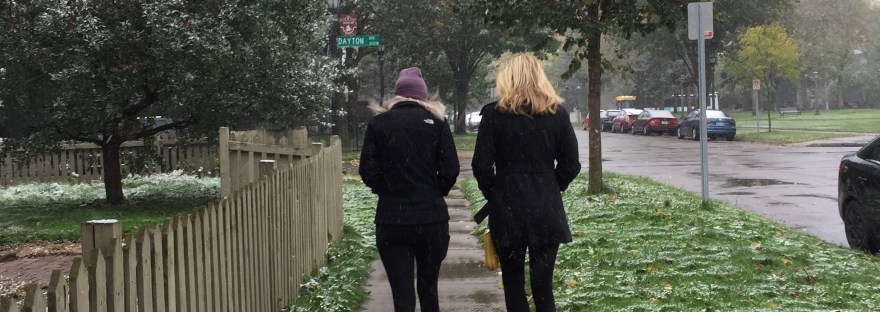
A close friend of mine named Jen kept a blog through a particular phase of her life. She began one memorable blog post in this way: “I have spent the last week seeing God everywhere, but principally in the disappearing spaces between people.” As I was praying over this text in preparation for this sermon, the memory of this friend’s words became gospel for me. It maybe sounds almost cruel to talk about the disappearing spaces between people as gospel when we’re in the middle of this extreme kind of physical distancing, but just stick with me here.
I have spent the last week seeing God everywhere, but principally in the disappearing spaces between people.
Church, I do think the scriptures promise us an ultimate future dwelling at the God’s side. And I confess my hope that God’s dwelling will be filled to overflowing with all kinds of surprising people – including ones of different faiths. But the promise of an other-worldly, heavenly home isn’t what stands out to me as I read John today. Instead, I hear a recounting of the disappearing spaces between people. I hear a story of relationship…a deep and intimate relationship between Jesus and his friends that is lived out not in the sweet by-and-by but in the grit and pain of an earthly existence which just hard as often as it is not.
And boy, were Jesus and his disciples in the thick of that grit and pain. This particular piece of John’s gospel unfolds on Thursday evening, the night before Jesus’ crucifixion. Jesus knows that he will soon leave this world and is trying to prepare his disciples for all that is about to take place. Just a few verses before the reading we heard today, Jesus told the disciples that one of them would soon betray him, and then he tells Peter that he will deny Jesus three times. It’s in this context that Jesus says, as we just heard, “Do not let your hearts be troubled.” Seriously, Jesus?! How could one’s heart be anything but troubled by all of this? Philip and Thomas and the others are afraid and, frankly, Jesus’ words about going to prepare a place for them, and coming back to take them with him, and reassuring them that they already know the way to the place he’s going, sound, like, actually a little bit crazy. So Thomas says it: “Jesus, we have no idea what you’re talking about. We don’t know where you’re going. We have no idea how to get there.” Jesus says, “Of course you know the way because I am the way, and the truth, and the life. If you have seen the Father, you have seen me. You HAVE seen him, and you know him.” Phillip enters the conversation with his own doubts. “Alright, Lord. SHOW us the Father and we’ll be satisfied.”
The disciples tend to get a bad rap in the gospels. They’re slow to understand and often slow to believe. But I read Thomas and Phillip’s questions and doubts not so much through a lens of thickheadedness. Instead, I see them as an illustration of the disappearing spaces between people…the disappearing spaces between them and Jesus. These disciples have walked a long road with Jesus, and Jesus is telling them that there is still a long and difficult road ahead. Their questions, to me, are an indication of the trust they have in their relationship with Jesus. That trust might not seem evident on the surface of their doubts, but somehow, their relationship with Jesus has deepened to the point where they are unafraid to be vulnerable with him, even in the midst of their fear and anxiety. A pastoral colleague of mine suggested last week that fear and anxiety, in tension with trust, is where we find the beginnings of hope. I think that’s right on.
“I’ve spent the week seeing God everywhere, but principally in the disappearing spaces between people.” This is a story about relationship. It’s about the relationship between Jesus and his friends. It’s also about the relationship between Jesus and the Father – the Mother – the Heavenly Parent. Phillip asks Jesus to show them the Father, and Jesus says, “Friends, you already know the Father because you know me. We dwell together, one within the other. There is no space at all between us. Believe that I am in the Father and the Father is in me. But if you can’t, believe because of the works themselves.” And oh, what works they have been!! The Way of Jesus, which these disciples have walked along with him, has been marked by acts of love that reveal the very face of God. Healing the sick. Raising the dead. Turning water into wine at a big ol’ party. Shedding holy tears along with his friends who were nearly destroyed with grief. Creating huge feasts for thousands of people out of simple fish and bread. Earthy, tangible works that change lives here and now, in this present moment, in this very time.
Beloved of God, these are anxious times. Here’s what I wonder. Dare we put that anxiety in tension with trust in the same Jesus who calls us just like he called those first disciples…who calls us again and again to allow the spaces between us and him to disappear…who calls us over and over into a deep and intimate relationship with himself? Dare we find hope in the midst of this anxiety? We HAVE seen God because we know Jesus. And we know Jesus through the radical ways in which he lived and loved and healed and served. We know Jesus for the ways he still shows up in the grit and pain of this earthly existence. Through his life, death, and resurrection he dissolved the spaces between us and him so that we might be freed to show a dead and dying world what resurrection looks like, feels like, smells like, and tastes like right here, right now. Yes, even in the midst of a pandemic.
You know the way to the place Jesus is going because you have already seen it. So as we gather again today around the abundant feast of bread and wine, rooted in relationship with the one who raises us from the graves of our own fears and anxieties, may we dare to live out the hope we find there. You know the way to the place Jesus is going because you have already seen it. So go! In whatever ways are safe and appropriate right now, Church, bring the hope you have come to know in Christ to the places he has first gone. Send notes of support to the sick and the suffering and to those who care for them, right down to the hospital custodians. Join the BEDS Plus meal train and provide for the hungry and the poor. Learn about Ahmaud Abery’s story and advocate on behalf of those who are victims of race-based violence in this country. Drop a care package on the porch of the neighbors you barely know, or make a gift to ELCA World Hunger in support of our neighbors across the oceans. And then notice as the spaces between God’s people begin to disappear, in spite of our physical distance. Amen.

 Heidi Torgerson